


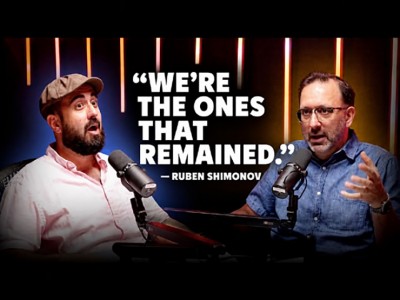
Interview by Roman Kaykov • Adapted for Publication by Shabsie Saphirstein
Original Kaykov TV interview premiered August 24, 2026Bukharian Jews have survived for roughly 2,500 years. Ruben Shimonov is less interested in celebrating that number than in asking what it will take to add another generation to it.
That question ran through his conversation with Roman Kaykov on Kaykov TV. The two men, both born in Tashkent, spoke about immigration, family, Jewish education, antisemitism, language, music, art, and the challenge of preserving a culture without turning it into a museum piece.
“Nothing stays the same,” Ruben said. “It always evolves.”
For Ruben, that is not an argument for abandoning tradition. It is an acknowledgment of how Bukharian Jews survived in the first place. Over centuries, the community lived through Persian, Greek, Arab, Turkic, Mongol, and Russian rule while repeatedly adapting to new languages, governments, and surroundings.
Ruben was born in Tashkent in 1987, during the Soviet Union’s final years, and left Uzbekistan at six and a half with his mother, sister, uncle, and maternal grandparents. The family traveled through Moscow before immigrating to New York in December 1993.
New York, however, was not his mother’s intended final destination. After several years, she moved the family to Seattle, seeking a calmer environment, natural beauty, and a strong Jewish community. Roman initially seemed surprised by the choice, joking about the New Yorker’s tendency to lump together almost everything outside New York.
Ruben saw his mother’s decision differently. To him, there was something deeply Bukharian about it: adjusting to circumstances, moving forward, and finding the environment she believed would give her children the best chance to thrive.
Seattle also gave Ruben an upbringing he would come to value deeply. He grew up in a Sephardic Jewish community whose roots included Jews from Turkey and Greece, alongside families from Iraqi, Iranian, Bukharian, and other backgrounds. His grandparents remained closely involved in his life, visiting Seattle for extended periods while Ruben returned to New York during summers.
His maternal grandfather, Ruben said, was particularly influential in instilling a love of Bukharian Jewish history and heritage. He also modeled something Ruben believes should accompany communal pride: humility.
“You can still be proud,” Ruben told Roman. “Don’t make yourself small. Don’t give in to the antisemites. But also be humble.”
That balance did not always come easily.
Ruben entered a new high school in Seattle in September 2001. On his third day of freshman year, the September 11 attacks took place. Shortly afterward, another student, knowing Ruben came from Uzbekistan, asked him, “What did you and your country do to us?”
Ruben knew the accusation made no sense, but he did not yet have the confidence to confront it as he would today. Instead, he became quieter about his Central Asian background. He even noticed his mother sometimes simplifying the family’s origins by telling people they were from Russia rather than explaining Uzbekistan to those unfamiliar with the region.
His response today is very different.
“My pride in being a Jew from Central Asia is firmly rooted in my love of my heritage,” he said.
That interest deepened in college, where Ruben studied Middle Eastern studies and international relations. He remembers asking professors knowledgeable in Jewish history for books about Bukharian Jews and discovering how little even Jewish studies scholars sometimes knew about the community or about Jews of the broader Islamic world.
After college, Ruben returned to New York, where Queens College Hillel gave him an unusual assignment. The college had a large population of Bukharian Jewish students, yet relatively few were engaging with Hillel. Ruben was brought in to help change that.
The experience helped shape an approach he still uses today.
Simply telling young Jews to be proud of their heritage, he said, rarely works. They need to discover what within that heritage speaks to them.
“You empower young people to make meaning of it on their own terms,” Ruben explained.
Someone interested in music can encounter Shashmaqam. Someone drawn to spirituality can learn about generations of Bukharian rabbis and religious figures. A student interested in commerce can discover the community’s long history of trade. The point is not to force identity upon someone, but to help that person find an authentic doorway into it.
At Queens College, that approach reached beyond Bukharian students. Ruben eventually worked with Persian, Georgian, Ashkenazi, and other Jewish students as well. The goal was not merely to make Bukharian students feel at home, but to broaden what all Jewish students understood Jewish life to include.
He recalled chaikhana-style lunch programs that attracted students from neighboring Muslim organizations as well. Afghan and Pakistani students would encounter familiar foods and cultural elements while learning that Jews had lived in Central Asia for centuries before the arrival of Islam.
Food helped start the conversation, but Ruben wanted students to leave knowing considerably more.
He wanted Ashkenazi students who might have encountered Bukharian Jews primarily through restaurants, weddings, or stereotypes to discover a community with its own scholars, literature, religious traditions, music, and intellectual history. Just as importantly, he wanted Bukharian students who had grown indifferent to their background to discover reasons to reconsider it.
Roman recalled hearing about a non-Jewish university student who chose Bukharian Jews as the subject of an academic thesis. What fascinated her, as he remembered it, was that such a comparatively small community had existed for more than 2,500 years.
Ruben understood the attraction immediately.
When he lectures on Bukharian Jewish history, he said, he wants audiences to see more than a chronology of rulers and migrations. He wants them to recognize the larger story: a small Jewish population continuing to exist as the civilizations around it changed.
“We’re the ones that remained,” Ruben said.
That history also shapes his work in the broader Sephardic and Mizrahi Jewish world. Ruben argued that Jewish history is distorted when it is taught as though the Jewish experience unfolded primarily in Europe. Jews maintained deep roots in Egypt, Libya, Yemen, Syria, Iran, Iraq, Uzbekistan, and elsewhere, alongside the continuous Jewish presence in Eretz Yisrael.
Understanding those histories, he said, expands the way Jews and non-Jews understand Jewish identity.
It also matters in confronting antisemitism. Ruben pointed to claims that Jews are simply Europeans foreign to the Middle East and argued that the histories of Sephardic, Mizrahi, and Central Asian Jewish communities directly challenge that narrative.
His preferred response is knowledge rather than aggression.
“We’ve always been the people of the book,” he said. “We’re the people of intellectualism.”
Ruben brings that same perspective to Jewish-Muslim bridge-building. Rather than hiding his Bukharian identity in interfaith settings, he said, he brings it with him. The shared histories, languages, artistic traditions, foods, and cultural references of Jews and Muslims from the Middle East and Central Asia can create openings that political discussions often cannot.
His interest in those connections is also expressed through art.
Music was always present in Ruben’s family. His father played violin, piano, drums, and other instruments. His grandfather loved both jazz and Shashmaqam and, during the Soviet period, would climb onto the roof in an effort to pick up Western radio broadcasts from Europe.
Languages became another fascination. Ruben grew up hearing Bukharian and Russian and later realized that words he had assumed were Russian were actually Bukharian expressions woven so naturally into family conversation that he had never distinguished between them.
Friendships with Persian speakers brought further recognition. In college, Ruben studied literary Persian in part so he could read classical Judeo-Persian texts written in Hebrew characters. That opened a literary tradition containing works and translations by Bukharian Jewish scholars whose names, he believes, deserve far wider recognition.
His language studies eventually included Hebrew, Persian, Arabic, Spanish, and others. What began as an intellectual interest developed into calligraphy.
Ruben began experimenting with Hebrew, Persian, and Arabic scripts on the same page, visually placing languages alongside one another that had interacted for centuries. What began as a personal project eventually became part of his public work.
During his first return to Uzbekistan in roughly 30 years, Ruben visited the residence of the United States ambassador and found a collection of his own artwork on display there.
The moment connected several parts of his life at once: Tashkent, America, Jewish identity, languages, and art.
Calligraphy has also become part of his educational and interfaith work. Ruben described a six-month fellowship through the American Sephardi Federation that brought together ten Jewish and ten Muslim young community leaders to explore Hebrew, Arabic, and Persian calligraphy.
When people ask how such a program could succeed amid political tensions, Ruben points to culture.
Art and music can create a common language where politics quickly erects walls.
Roman connected the idea to Kaykov TV’s documentary work on Bukharian musical figures. He recalled filming a detailed piece in which a musician spoke about his instruments one by one, explaining how he acquired them and what each meant to him. The conversation moved through laughter, tears, memories, and music.
Ruben immediately understood the importance of preserving those moments.
He pointed to Shashmaqam musicians whose artistry remains beloved not only among Jews but among Muslims in Uzbekistan and Tajikistan. For him, this is evidence of culture’s ability to preserve memory while building relationships across communities.
It also illustrates why preservation cannot mean insisting that every generation express Bukharian culture exactly as the one before it did.
Roman remembered predictions after the large Bukharian immigration to the United States that the culture would disappear within 15 or 20 years. It did not. Families built synagogues, institutions, businesses, newspapers, schools, musical traditions, and now digital platforms and podcasts.
Ruben believes those newer forms are not signs that the culture has weakened. They can be evidence that it is still alive.
He compared the idea to something flexible rather than brittle. Grass bends; a rigid twig snaps.
“The secret,” Ruben said, is making tradition “attractive, warm, welcoming, inviting.” When that happens, younger people are more likely to preserve what they inherited while also making it their own.
The conversation became more sensitive when Ruben raised young Bukharian Jews who feel alienated from their families or community because they have not followed expected paths. He mentioned people whose professions, marital status, or other life choices do not fit accepted social norms.
Roman challenged the tendency to blame “the community” or a rabbi for everything that happens inside a family. Community life, he argued, begins at home.
Ruben agreed. The openness he was describing has to begin there as well.
Both rejected a simplistic view in which either parents or children bear all the blame for strained relationships. Children have obligations toward their parents, while parents have a particular responsibility for the children they brought into the world. Relationships require work from both sides.
Ruben was especially critical of decisions driven primarily by fear of embarrassment or by concern over “what the community will think.” A family, he suggested, can maintain standards and traditions without allowing social image to become more important than the relationship itself.
That discussion returned the conversation to its central question. What exactly does it mean to preserve a culture?
For Ruben, preservation does not require recreating Tashkent, Bukhara, Samarkand, or Dushanbe in New York, Seattle, or Detroit. Bukharian Jewish life changed even while Jews still lived in Central Asia. Russian entered the vocabulary. Political systems changed. Music developed. Families moved. Communities adjusted.
What mattered was that something essential continued.
Near the end, Roman asked Ruben what he hopes for the future of Sephardic and Mizrahi Jewish identity.
Ruben pointed to the unprecedented mixing taking place throughout the Jewish world. In Israel especially, a single family might now carry Tunisian, Romanian, Yemenite, Syrian, or other Jewish ancestries. Some people mourn that blending, fearing distinct traditions will eventually disappear.
Ruben does not dismiss that concern, but he sees possibility in what is emerging.
“I’m ready for the next chapter,” he said.
He hopes that chapter will make room for both Jewish diversity and Jewish unity: communities knowing where they came from without losing sight of what they share.
For Bukharian Jews, that may be the same challenge their ancestors repeatedly confronted. The surroundings change. Languages change. Countries change. Methods change.
The responsibility to carry the story forward does not.
Ruben Shimonov is an educator, community builder, artist, and advocate for Bukharian, Sephardic, and Mizrahi Jewish heritage. Born in Tashkent and raised in the United States, he previously worked with Bukharian and other Jewish students at Queens College Hillel. He currently serves as National Director of Sephardi House and Education at the American Sephardi Federation. His work encompasses Jewish education, community building, interfaith engagement, languages, and Hebrew, Persian, and Arabic calligraphy.
Roman Kaykov is president of Kaykov Media and host and senior producer of Kaykov TV. Through Kaykov TV, Roman brings rabbis, educators, community leaders, entrepreneurs, artists, and other personalities into the studio for conversations about Jewish life, Bukharian identity, family, culture, faith, business, and community.
The Kaykov Exchange: Inside the Studio. Beyond the Conversation.
2,500 Years Later, What Will Keep Bukharian Jewish Identity Alive? Ruben Shimonov On Heritage, Resilience, Family, And The Next Generation
Typography
- Smaller Small Medium Big Bigger
- Default Helvetica Segoe Georgia Times
- Reading Mode