


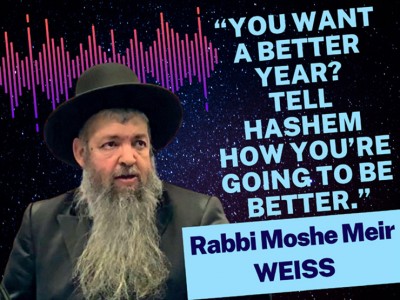
Rabbi Moshe Meir Weiss On Turning Elul Inspiration Into A Practical Plan
Elul can easily become a month of good intentions. The shofar sounds, Selichot begin, and people speak about teshuvah and the approaching Yom HaDin. Yet Rosh Hashanah can arrive with all that inspiration never having reached the kitchen table, the office, the car, or the way we speak to those closest to us.
Longtime marbitz Torah Rabbi Moshe Meir Weiss joined Chazaq Torah Talks to share a clear, practical approach: sit down, walk through an ordinary day from beginning to end, and make an honest list of what can be better. Not what sounds impressive or what somebody else should improve. What can I do differently this year?
When asked what a person should do first in preparing for Rosh Hashanah, the answer began with a cheshbon hanefesh. Take a piece of paper and mentally walk through the day, beginning with Modeh Ani and ending with Hamapil. At each stop, ask: Is there something here I can do better?
In the morning, do I say Modeh Ani? Do I wash netilat yadayim properly? Do I pause for Asher Yatzar, or am I already turning toward the phone or computer? When I put on tzitzit, do I ever think about what they represent?
At home, do I smile at my spouse? Offer a compliment? Help when help is needed? Am I giving my children enough time, attention, and patience? One line from the conversation captured that beautifully: “The best present you can give your children is more of your presence.”
At work, the Gemara famously asks, Nasata v’natata be’emunah?—did you conduct your business faithfully? The word emunah adds another layer: Do I conduct myself with the awareness that Hashem is looking over my shoulder? Am I honest when nobody would know otherwise? Is my speech clean even when those around me speak differently? Do I make berachot slowly enough to know what I am saying? Do I notice the mezuzah, or has it become part of the scenery?
This accounting reaches further. How much Torah do I actually learn? Do I understand the words of my tefillah? Am I giving enough tzedakah? Are there areas of tzniut that deserve more attention?
And then there is the car. Do I let someone merge? Do I lean on the horn late at night when families are sleeping? Do I double-park and block someone because it is convenient? When people encounter my behavior, do they leave thinking more highly of a Jew and of Torah?
That is where Elul becomes real. A cheshbon hanefesh follows a person into business, marriage, parenting, eating, driving, speech, money, and every routine interaction that makes up a day.
The shofar itself points toward that work. Its call is associated with shipru ma’aseichem—beautify your deeds. The point is not merely to create an emotional atmosphere, but to identify what needs attention and begin improving it.
The result should be what the Rav called a “to-do-better list.” We come to Rosh Hashanah and do not merely want another year. We want a better year—better parnasah, better shalom bayit, better everything. Hashem says, in effect: No problem. Tell Me how you are going to be better.
In that light, finding something that needs improvement is not discouraging. It gives a person something concrete to work on before Rosh Hashanah.
The next step is strengthening the merits that can help a person enter the Yamim Nora’im with greater protection and blessing. The familiar answer appears in the liturgy: teshuvah, tefillah, and tzedakah.
Tzedakah opportunities are often right in front of us. A large family buying shoes and sneakers for eight children can face a heavy burden, especially with Shabbat shoes as well. Others may be struggling with tuition, groceries, or school registration. The advice was simple: notice relatives, neighbors, and people we actually know who can use help.
Money is not the only way to become a merit to someone else. Call someone who is lonely. Cheer up a person who is struggling. Be the friend who shows up. Become the husband whose wife is happy to see him come home, or the wife whose husband knows there is warmth and support waiting at home. Be the parent whose presence gives children security.
This is a tremendous merit, though not a guarantee against tragedy. The question Elul asks is not only, “What did I do wrong?” It also asks: Who benefits because I am here?
The final recommendation returned to the value that has defined so much of the Rav’s life: Torah learning. The Gemara describes Torah as magna u’matzla—it protects and saves. When we ask Hashem for another year, we should be able to say honestly: If You give me another year, I intend to use more of it for Torah.
That may mean adding a shiur, beginning Daf Yomi, or becoming consistent with Shnayim Mikra v’Echad Targum. The particular program matters less than making a real commitment that fits life.
The Rav has seen what one small Torah decision can become. A simple sign advertising a Daf Yomi shiur led one man to attend and continue learning night after night for decades. On another occasion, a radio announcement encouraged listeners to begin Daf Yomi with the promise that seven and a half years later they could complete Shas. One listener took that message seriously and eventually completed Shas multiple times.
Small initiatives can grow into lifetimes of Torah and mitzvot. That is why efforts like Chazaq’s matter so much. A flyer, an invitation to a program, or an effort to place a Jewish child into yeshivah may look small in the moment, yet no one knows how many years of Torah, families, and future generations may grow from that one action.
By Rosh Hashanah, the “to-do-better list” should no longer be a collection of vague resolutions. It should reflect an Elul spent noticing where life can improve and beginning to act on it.
We will ask Hashem for life, health, parnasah, family, peace, and blessing. The challenge is simple: Do not come only asking for a better year. Come ready to show how you intend to be better. The shofar calls; Elul gives us the time to decide what we are going to do about it.
Rabbi Yaniv Meirov is the mara d’atra of Kehilat Charm Circle in Kew Gardens Hills and serves as Chief Executive Officer of Chazaq. Now 222 episodes strong, Chazaq Torah Talks continues to inspire by showing that Jewish growth and survival are shaped through lived experience, commitment, and connection.
Before You Ask Hashem For A Better Year, Ask How You Will Be Better
Typography
- Smaller Small Medium Big Bigger
- Default Helvetica Segoe Georgia Times
- Reading Mode