


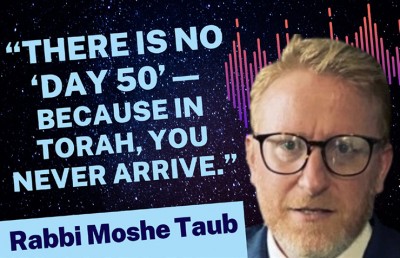
Rabbi Yaniv Meirov sat down with Rabbi Moshe Taub, Mara D’asra of Young Israel of Holliswood and Rabbinic Editor and columnist for Ami Magazine, for a down-to-earth take on one of the most overlooked ideas during Sefirat HaOmer: Are we just counting days, or actually growing through them?
Counting Toward Something
Sefirah is not just a countdown—it’s a process.
Rabbi Taub described it simply: A child counts down to a trip, building excitement each day. But once the day arrives, the counting ends.
With Sefirah, though, we never say “Day 50.”
Why?
Because in Torah life, there’s no point where a person can say, “I’ve arrived.” Even when we reach Shavuot, we’re not finishing—we’re starting again.
We left Mitzrayim not only to get out, but to move forward. The counting reflects both—leaving what holds us back, and building toward something greater.
A Time Of Mixed Emotions
Sefirah carries two emotions at once.
On one side, we’re building toward receiving Torah. On the other, we mourn the loss of Rabbi Akiva’s 24,000 students.
But these aren’t contradictions.
The loss wasn’t just numbers—it was lost Torah, lost greatness, and generations that never came to be. Just as we reflect on the Holocaust not only as lives lost, but as Torah and potential that disappeared with them, the same applies here.
And the truth is—we don’t fully understand what we’re missing.
Like the soldier at the Kosel who cried without knowing why, we feel the loss even if we can’t fully explain it.
What Went Wrong?
Rabbi Taub raised a difficult question: Why did this tragedy happen specifically to Rabbi Akiva’s students?
His answer offers a powerful perspective.
Rabbi Akiva’s growth came later in life. His students reached incredible heights in Torah—but may not have seen, up close, what refined interpersonal conduct looks like in daily life: how a Rav interacts, how a Rebbetzin builds a home, and how Torah is lived between people.
They learned Torah—but may have lacked the experience of seeing it lived.
It’s a reminder: Torah isn’t only learned—it’s absorbed by watching how it’s lived.
Beyond The Technical
Counting correctly matters. Halachah matters.
But it’s easy to stop there.
Rabbi Taub pointed out that we can become so focused on doing things perfectly that we lose sight of what matters most.
He gave a practical example from Pesach. Not everything needs to be cleaned. “Spring cleaning” isn’t a Jewish requirement. Going beyond the basics has its place—but not at the expense of priorities.
“If you want to take something on,” he said, “start with kavanah.”
The same applies to Sefirah. The counting is important—but what are we doing with it?
Seeing More In The Same Moment
Rabbi Taub shared a story from Niagara Falls.
Different people looked at the same scene and saw completely different things:
One saw a halachic question.
Another heard shirah.
A third saw a lesson in humility—the noise above, the calm below.
Same view—completely different depth.
Sefirah can be the same. It can remain routine—or become meaningful.
Using What We Have
He compared this to something familiar.
Most people use their phones for basic functions, even though they’re capable of much more.
Mitzvos can be the same way.
We can go through them—or grow through them.
Starting Again
Lag BaOmer is not just a break in mourning.
It marks something deeper.
After losing 24,000 students, Rabbi Akiva didn’t stop. He rebuilt—with just five students.
That’s the message.
No matter what a person has been through, no matter how much they feel they’ve lost—there is always a way to begin again.
A Story That Stays With You
Rabbi Taub shared a story that’s hard to forget.
In Auschwitz, a man who hadn’t had tzitzis for years asked another prisoner if he could wear his for just a moment to make a brachah.
As he did, he was beaten.
When it was over, he returned the tzitzis and simply said, “Thank you.”
He later kept them hidden for years.
In the darkest times, Jews risked everything for a single mitzvah.
Today, with far more comfort, we sometimes struggle with consistency.
Stories like this aren’t meant to make us feel guilty—they remind us what we’re capable of.
What It Means To Count
Sefirah isn’t about marking time. It’s about using it. Each day is an opportunity—to grow, to think, and to become more aware and intentional. We’re not just moving toward Shavuot. We’re becoming people ready for it.
“Don’t just count the days—make the days count.” If nothing changes, then the counting stayed on the surface. But if even one thing improves—one habit, one relationship, one step—then something real has begun. Because in Torah life, there’s no final day.
Just the next step forward..
Rabbi Yaniv Meirov is the mara d’atra of Kehilat Charm Circle in Kew Gardens Hills and serves as Chief Executive Officer of Chazaq.
Now 222 episodes strong, Chazaq Torah Talks continues to inspire by showing that Jewish growth and survival are shaped through lived experience, commitment, and connection.
Don’t Just Count The Days—Make The Days Count
Typography
- Smaller Small Medium Big Bigger
- Default Helvetica Segoe Georgia Times
- Reading Mode