


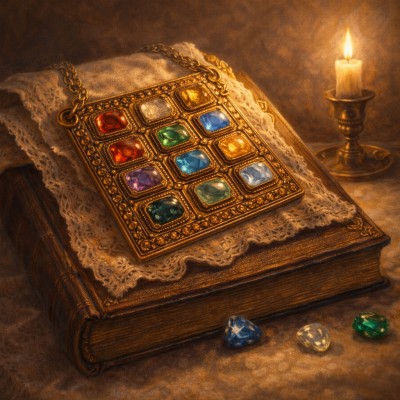
“Odem, Pitdah, and Bareket — the first row of the stones.” (Shemot 39:10)
Rav Wacsman, shlit”a, Rosh Yeshivat Me’or Yitzchak, once shared a remarkable story from youфth that reveals the proper perspective educators and parents must have toward children.
As a young student learning in cheder, the teacher was a Hungarian Jew — a Holocaust survivor who had endured the horrors of the German inferno during the war years. The class itself was lively, energetic, and at times quite mischievous. Whenever the boys crossed a certain line of behavior, the teacher would quietly begin muttering strange words under the breath. To the children, it sounded like Hungarian curses.
This curious scene repeated itself many times during the year.
Eventually, at the end of the school year, when the students came to thank the teacher and bid farewell, one boy gathered the courage to ask the question that had been on everyone’s mind.
“Rebbe,” the boy asked, “what were those Hungarian words you used to mutter whenever we misbehaved?”
The teacher smiled and answered:
“Those were not Hungarian curses at all. I was reciting the names of the stones of the Choshen — the breastplate worn by the Kohen Gadol — as they are translated by Onkelos:
Samkan, Yarkan, u’Varkan; Izmargadin, Shavziz v’Savhalom; Kankerei Tarkaya v’Ein Eglah; Krum Yama u’Burla u’Panteri.
Whenever the class began to frustrate me, I would remind myself: True, these boys are irritating me right now — but every child is a diamond.
Even when a child behaves wildly, that child is still one of the stones of the Choshen. One boy is an Odem, another a Pitdah, another a Bareket. Right now the behavior may appear unruly, but as life unfolds that same child will channel those energies toward good.
The behavior we see today is only external. Inside, the child is a shining diamond.”
By repeating the names of the stones, the teacher was reminding the heart of this truth and calming the frustration that naturally arises when dealing with difficult moments in the classroom.
This story offers a powerful reminder: childhood behavior is not destiny. The energy that appears chaotic today may later become strength, leadership, creativity, or passion. What seems like disorder may in fact be the raw material of greatness waiting to be shaped.
When educators and parents learn to look beyond the surface and recognize the precious soul within each child, patience becomes easier and guidance becomes more effective. The task is not merely to correct behavior, but to nurture the diamond hidden within.
Rav Yaakov Shaish, shlit”a, relates this teaching in the sefer Na’eh Doresh.
Rabbi Leeor Dahan, a graduate of Yeshiva Chofetz Chaim/RSA, is a noted scholar and teacher, well-versed in halachah. He currently leads Kehilat Avodat Hashem in Hillcrest, Queens, inspiring his congregation to delve into Torah study and embrace its eternal teachings.
Every Child Is A Diamond
Typography
- Smaller Small Medium Big Bigger
- Default Helvetica Segoe Georgia Times
- Reading Mode