


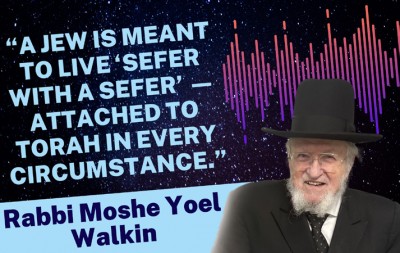
Lessons Of Mesorah And Living Torah From Rav Moshe Yoel Walkin
In Episode 113 of Chazaq Torah Talks, Rabbi Yaniv Meirov welcomed Rabbi Moshe Yoel Walkin for a deeply moving conversation titled Remembering the People of Yesteryear. The episode served not merely as an interview, but as a living bridge to an earlier generation — one shaped by unwavering dedication to Torah, sacrifice, and unbreakable faith through some of Jewish history’s most turbulent eras.
Rabbi Meirov was joined by Rabbi Moshe Yoel Walkin’s son, Rabbi Avrohom Walkin, director of Chazaq’s JWave Boys Teen Division, who co-hosted the episode. Together, father and son reflected on family legacy, the transmission of Torah across generations, and the personalities who shaped the Torah world that exists today.
Rabbi Walkin’s story begins in Radin, the famed town of the Chofetz Chaim. Though he left as an infant, Radin represented far more than a birthplace; it symbolized a world where Torah life defined every aspect of daily existence. From there unfolded a remarkable family lineage rooted in giants of Torah scholarship.
Central to the discussion was Rabbi Walkin’s grandfather, the Beis Aharon, whose sefarim became widely studied throughout the Torah world, reflecting a style of learning rooted in clarity and truth. Even during periods of Communist persecution and imprisonment, Torah learning continued uninterrupted — a reality that reflected the spiritual resilience of that generation.
Stories shared during the episode illustrated how Torah greatness was measured not only by scholarship but by devotion. Rabbi Walkin described individuals so deeply connected to their teachers that the loss of a rebbe felt like losing a parent, demonstrating the depth of the rebbe-talmid relationship that once defined yeshivah life.
The conversation then turned to the upheaval of World War II. Rabbi Walkin recalled fleeing Europe and eventually arriving in Shanghai, one of the few places that accepted Jewish refugees during the war. As a child, he witnessed bombings, wounded soldiers, and the uncertainty of wartime existence. Yet even amid chaos, Torah learning and communal responsibility remained central.
From Shanghai, the family eventually immigrated to the United States, settling first in Brooklyn. Rabbi Walkin would go on to learn in some of the most influential yeshivot of the postwar era, including Telshe and later the Mir. There, he encountered legendary roshei yeshivah whose approach to learning emphasized intellectual honesty and clarity over complexity.
He recalled how great teachers sought the straightforward truth of the Gemara rather than intellectual showmanship. Torah, he explained, was never meant to be obscure; its greatness lay in revealing clarity through deep effort.
Rabbi Walkin also shared memories of Rav Moshe Feinstein, ztk”l describing not only his towering halachic authority but his remarkable ability to understand people. Rav Moshe’s greatness, he noted, was rooted in a profound grasp of both Torah and human nature, enabling him to guide individuals with wisdom and compassion.
After marriage, Rabbi Walkin eventually settled in Kew Gardens, where he would spend decades serving and uplifting the Bukharian Jewish community. When he first arrived, many families possessed strong traditional feelings but limited formal Torah education. Rather than confrontation, his approach centered on patience, warmth, and respect.
Step by step, families grew closer to Torah observance. Over the years, countless individuals strengthened their connection to Jewish life — building homes centered around Shabbat, mitzvot, and Torah study. Rabbi Walkin emphasized that transformation rarely happens overnight; lasting growth comes through relationships and genuine care.
Throughout the episode, Rabbi Meirov highlighted Rabbi Walkin’s lifelong commitment to learning. Family members recalled seeing him study Torah at all hours, even adapting when circumstances made learning difficult. One powerful memory described how, when a light went out late at night, he simply moved to another small source of light and continued learning uninterrupted.
For Rabbi Walkin, Torah study was never bound by convenience. It defined existence itself.
This philosophy was captured in one of the episode’s most memorable teachings: a Jew must live “with a sefer” — always connected to Torah. Learning was not confined to formal settings but accompanied a person through every stage and circumstance of life.
As the conversation drew to a close, Rabbi Walkin shared a powerful metaphor. Jewish continuity, he explained, is not about creating something new. Like a severed cable repaired after being cut, each generation reconnects to the chain that preceded it. The mission is restoration — reconnecting to a heritage that never truly disappears.
The episode concluded with a sense of gratitude and responsibility. The stories of previous generations are not merely historical memories; they are living lessons guiding the present. Through dedication to Torah, education, and community outreach, the work of strengthening Jewish identity continues — ensuring that the legacy of yesterday remains alive for tomorrow.s.
Rabbi Yaniv Meirov is the mara d’atra of Kehilat Charm Circle in Kew Gardens Hills and serves as Chief Executive Officer of Chazaq.
Now 222 episodes strong, Chazaq Torah Talks continues to inspire by showing that Jewish growth and survival are shaped through lived experience, commitment, and connection.
Remembering The People Of Yesteryear
Typography
- Smaller Small Medium Big Bigger
- Default Helvetica Segoe Georgia Times
- Reading Mode