


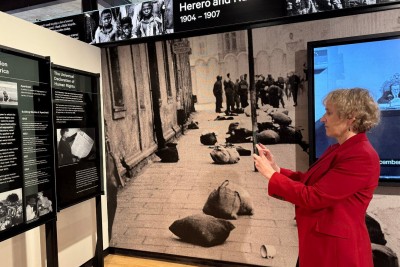
“We don’t want to let countries run out the clock,” Ellen Germain, U.S. special envoy for Holocaust issues, told JNS.
Ellen Germain’s office at the U.S. State Department, where she is special envoy for Holocaust issues, gets a lot of attention on International Holocaust Remembrance Day but continues year-round out of the spotlight, Germain told JNS in a recent interview.
As Holocaust survivors age and their numbers, sadly, dwindle, Germain has been thinking a lot about the youngest among their ranks, including on a visit to Austria to mark the liberation of Mauthausen, where she met three survivors, who were born on trains to the concentration camp in the waning days of the war.
“It’s incredible how they survived,” she told JNS. “One of the babies was three pounds when she was born, and I think her mother was something like 70 pounds.”
“Their survival is unbelievable, and the three of them only met each other and knew about each other’s existence in 2010,” she said. “They didn’t realize there were others.”
The three have gotten together every five years or so since 2010, Germain told JNS.
“These really beautiful, smiling, sharp people, whose start in life was so horrific,” she said. “It’s a testament to human spirit and to the way people are able to survive in the most horrific of circumstances.”
The special envoy told JNS that her office focuses on two main issues—restitution for property stolen from Jews and supporting accurate Holocaust commemoration and education.
On the former, she works with the Conference on Jewish Material Claims Against Germany and the World Jewish Restitution Organization.
“Both of those organizations work really hard to, for example, get pensions, health care and home care support for survivors,” she told JNS. “That’s the kind of thing that’s necessary year round, and even more so now, because even the youngest survivors are in their early 80s.”
“We need to all help them to live in dignity in their last years,” she said.
Germain would not discuss ongoing litigation but told JNS that she hopes at least some current court cases will have positive outcomes for survivors. She also said that the Trump administration is exerting pressure where needed.
“This administration has been crystal clear in its condemnation of antisemitism and in its advocating for survivors,” she said. “I am taking advantage of it in every way I can to try and help the survivors.”
Germain told JNS that she spoke late last week with a U.S. ambassador overseas—she didn’t say which—who was “gung ho about pushing forward and trying to get the country where that ambassador is posted to finish up its restitution and compensation issues.”
A “significant” number of survivors can still benefit from finalized restitution or pension claims in their declining years, according to Germain.
“We don’t want to let countries run out the clock,” she told JNS.
In her office’s other emphasis—Holocaust education and commemoration—Germain and colleagues counter Holocaust distortion and denial, which she called “a pernicious form of antisemitism” that “is sadly and frighteningly on the rise worldwide.”
The Trump administration both aims to combat that and has decried some European governments for what it sees as violations of free speech rights, particularly on social media. Washington has even sanctioned some people for those violations, including Imran Ahmed, who runs the Center for Countering Digital Hate and has worked with mainstream Jewish groups to combat Jew-hatred.
A British native and U.S. green card holder, Ahmed was a “key collaborator with the Biden administration’s effort to weaponize the government against U.S. citizens,” Sarah Rogers, State Department undersecretary for public policy, stated on Dec. 23.
It wasn’t immediately clear why Ahmed was sanctioned, though his organization is embroiled in legal challenges with X, the social media platform formerly called Twitter, which on-again-off-again Trump ally Elon Musk owns, over hate speech, including Holocaust denial, on the platform.
“The administration and State Department have been crystal clear and unambiguous about our condemnation of antisemitism and of Holocaust distortion and denial,” Germain told JNS. “We’ve also been very clear that we do not support legal restrictions on freedom of speech.”
“We can, however, condemn speech that we disagree with as a policy matter,” she said.
In addition to policy focuses, Germain told JNS that her work is deeply personal.
Last year, she interviewed Eugene Bergman, a Holocaust survivor who was attacked, at age 9, by a soldier in Poland with a blow to the head that left him deaf.
Bergman joined the Polish resistance movement as a child before his family came to the United States, where he later earned a doctorate in English literature and became an English professor at Gallaudet University, a school in Washington that educates students who are deaf and hard of hearing.
“He’s just such a funny, nice man to talk to,” Germain told JNS. “Every time I hear a new story from a survivor, I marvel at how each story is different.”
“I could listen to them all day,” she added.
By Mike Wagenheim (Jan. 27, 2026 / JNS)
Trump Admin ‘Crystal Clear’ On Aiding Holocaust Survivors, Fighting Jew-Hatred, Special Envoy Says
Typography
- Smaller Small Medium Big Bigger
- Default Helvetica Segoe Georgia Times
- Reading Mode