


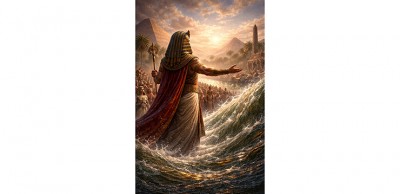
Pharaoh saw himself as a g-d. He declared, “The Nile is mine, and I made myself.”
How could such foolishness take hold of a human being?
Our forefather Yaakov Avinu felt genuine gratitude toward Pharaoh. Pharaoh had removed Yosef from prison, elevated him, and appointed him viceroy over Egypt. In return, Yaakov blessed Pharaoh with greatness, telling him that whenever he would come to the Nile, its waters would rise toward him.
And indeed, this is exactly what happened. Each time Pharaoh approached the Nile, the waters rose to greet him.
The Nile itself was worshipped as a deity by the Egyptians. When they saw the river rising toward Pharaoh, they concluded that Pharaoh must be a god even greater than the Nile. What began as a misunderstanding slowly transformed into belief, and belief into certainty. People began to speak of Pharaoh as possessing divine powers.
Pharaoh heard this repeatedly. He saw the people’s awe and unquestioning reverence — and eventually, he too came to believe it. It was easy for him to forget that this phenomenon was not self-generated, but the result of Yaakov Avinu’s blessing.
“If everyone believes it,” Pharaoh reasoned, “it must be true. Indeed, I am a g-d. I created the Nile.”
With this delusion firmly rooted, Pharaoh issued a harsh decree throughout Egypt: every night, between two and four in the morning, no one was permitted to rise from bed. Anyone who did so would be executed.
How did Pharaoh justify such a bizarre command? He announced that during those hours he needed complete solitude to perform mystical acts in order to raise the Nile — to irrigate the fields, bring forth fish, and provide abundant drinking water. Elevating the Nile, he claimed, was no simple task.
But how can a person come to believe a lie he himself invented?
In Novardok, this was explained through a parable.
A man once wanted to take an afternoon nap, but beneath his window stood a lively group of children playing ball. They shouted and laughed so loudly that sleep was impossible. He tried scolding them, but it didn’t help. He tried reasoning with them, but that failed as well.
Finally, an idea struck him.
He opened the window and shouted, “Hey! You’re missing out!”
The children paused and looked up. Seizing the moment, he called out, “What, you’re not running to the magician? Don’t you know that right now a magician from India is giving a free performance at the entrance to the city? He pulls doves from hats, ducks from sleeves, swallows knives, and puts his hand into fire without being burned — all for free! Run!”
The children immediately ran off, and the man smiled, certain that peace and quiet had finally arrived.
But that is not what happened.
As the children raced through the city’s main streets, passersby and shopkeepers asked what was happening. When they heard about the magician, they joined the run. The crowd grew rapidly. The rumor spread like wildfire. From every direction, people streamed toward the city entrance — men, women, children, babies in strollers, and even elderly people in wheelchairs pushed along by caregivers.
The man who had fabricated the entire story just to get some sleep had no idea what was happening. The children were gone, but now the noise was far louder than before.
He opened the window and stared in disbelief. Thousands of people were running, the roar deafening.
“Hey!” he called to a man rushing past. “What’s happening? Where is everyone going?”
The man stopped briefly and scolded him, “Don’t pretend you don’t know!”
“I really don’t know,” the man insisted. “I was lying in bed. What’s going on?”
Impatient to continue running, the passerby replied, “What, you haven’t heard? A magician from India is performing at the city entrance — for free!”
“What? It’s real?” the man exclaimed. “I thought I just made it up…”
He grabbed his coat and hat and ran with the crowd to see the magician.
Why?
Because when everyone believes something, it feels undeniable.
Pharaoh came to the Nile, and the waters rose toward him. Everyone said, “Who knows what powers Pharaoh possesses…” And when everyone believed he was a g-d, Pharaoh concluded the same.
But Hashem declared otherwise.
“Come, and I will show you who you are. You are like the great serpent — but your end will be to become a staff, dust and ashes.”
Based on a teaching by Rabbi Meir Tzimrot, shlit”a, Haggadat Doresh Tov
Rabbi Leeor Dahan, a graduate of Yeshiva Chofetz Chaim/RSA, is a noted scholar and teacher, well-versed in halachah. He currently leads Kehilat Avodat Hashem in Hillcrest, Queens, inspiring his congregation to delve into Torah study and embrace its eternal teachings.
PHARAOH’S SELF-PROCLAIMED GODLINESS: A Lesson In Human Delusion
Typography
- Smaller Small Medium Big Bigger
- Default Helvetica Segoe Georgia Times
- Reading Mode