


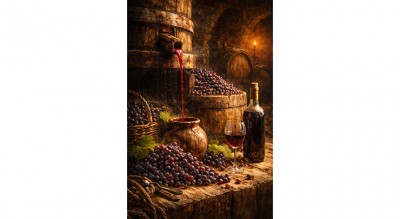
“And he washed his garments in the blood of grapes.” (Bereshit 49:11)
At first glance, these words are puzzling. What meaning lies in such a striking image?
The Or HaChaim HaKadosh offers a profound explanation—one that reframes how we understand hardship, delay, and moments that appear to be decline.
The Vineyard That Looks Ruined
When a vineyard owner wants to produce fine wine, he does something that seems counterintuitive: he leaves the grapes on the vine far longer than expected.
To the casual observer, the grapes initially look perfect—large, plump, beautiful, bursting with juice. Yet the owner does not harvest them. Then the sun begins to beat down. Here a brown spot appears, there a black mark. Slowly, the grapes shrivel and wrinkle.
The observer shakes his head.
“This owner is lazy,” he thinks. “Earlier the grapes were magnificent—now they are ruined.”
But the observer does not understand the process.
The vineyard owner takes those shriveled grapes into a dark cellar and crushes them. Skins, pits, pulp, and juice mix together. A sharp, unpleasant smell fills the room. The juice—the “blood of grapes”—flows freely, and nothing about it looks promising.
Then the mixture is sealed in a barrel and left to ferment for forty days.
Only at the end does the miracle become visible:
a refined, fine wine emerges.
When Life Looks Like Blood, Not Wine
The Or HaChaim teaches that the greatest moments in life are often those very moments that resemble the blood of grapes—times when everything appears shriveled, dark, and broken, and the final outcome is completely hidden.
The unwise person despairs.
The wise person understands: this is part of the process.
A Broken Heart at Twenty-Six
There was once a young Hasidic man who reached the age of twenty-six without finding his match. Suggestions came and went, uninspiring and recycled. Each disappointment left him more discouraged than the last.
Then, suddenly, hope arrived.
A promising suggestion came from America: a refined, modest young woman from a respected and well-established family. The young man was overjoyed. Finally—something real.
The matchmaker explained that the young woman and her family were coming to Eretz Yisrael. She would be meeting several young men.
The young man said eagerly, “You usually receive a thousand dollars for a match? From me you’ll receive thousands. As soon as they land and recover from the flight, call them immediately—push with all your strength!”
The matchmaker agreed. “They’ve heard very good things about you.”
The next morning, the young man opened the newspaper.
His heart sank.
The young woman was engaged—to someone else.
A Trip That Never Happened
Seeing their son crushed, his father said, “We need to go recharge at the kever of Rebbe Shimon bar Yochai in Meron.”
Snow was expected in the north, so the parents decided to take the children along. The plan was to leave early before the roads closed.
At nine in the morning, the father went down to the car with all the children. Everyone was seated and ready. Only the mother and the young man were still upstairs.
Just then, they noticed an elderly man knocking on the neighbor’s door—the community charity collector. No one answered.
The man turned to them and said quietly, “I came from out of town to see him, but he’s not home. Could I have a cup of water?”
The young man sensed that someone asking for water likely needed more than water.
They invited him inside, seated him comfortably, and served him coffee and cake.
Downstairs, the father called impatiently,
“Hurry up! The roads will close—we won’t be able to travel!”
The mother replied, “We have a guest. We’ll be down shortly.”
The guest drank slowly. He ate unhurriedly. He seemed to have all the time in the world.
After several minutes, the young man asked for a blessing to find his match. The guest blessed him warmly.
Soon afterward, the young man became engaged—joyfully and successfully. The wedding date was set nearly a year later.
The Wine Revealed
On the day of his wedding, as he sat reflecting and thanking Hashem, a startling realization struck him.
The wedding date was exactly one year to the day from when that elderly guest had entered his parents’ home—precisely when everyone else was already in the car.
The young man later said:
“I thought salvation would come from a four-hour trip to Meron. In the end, it was the guest who arrived at the exact moment of my greatest disappointment who brought me my blessing.”
Owning the Shriveled Moments
A Jew who knows how to seize the “wrinkled” moments—the moments that look like loss, delay, and failure—and turn them into acts of kindness, patience, and faith, holds the key to success in every area of life.
Because the blood of grapes is not the end.
It is the beginning of wine..
Rabbi Leeor Dahan, a graduate of Yeshiva Chofetz Chaim/RSA, is a noted scholar and teacher, well-versed in halachah. He currently leads Kehilat Avodat Hashem in Hillcrest, Queens, inspiring his congregation to delve into Torah study and embrace its eternal teachings.
The Blood Of Grapes: Finding Blessing In Life’s Wrinkled Moments
Typography
- Smaller Small Medium Big Bigger
- Default Helvetica Segoe Georgia Times
- Reading Mode