

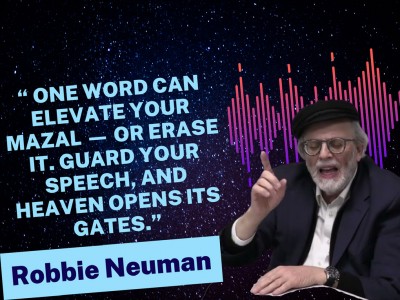
There are episodes that inspire, and then there are episodes that jolt the neshamah. Episode 42 of Chazaq Torah Talks with our dear friend Mr. Robbie Neuman was one of those moments — a raw, urgent, deeply Torah-rooted conversation about the true mechanics of mazal and how a Jew can transform his destiny through the power of his mouth.
From the very first minutes, Robbie’s message was unmistakably clear: your mazal rises or falls on your speech. Before diving into that core lesson, he shared warm glimpses of who he is — the engine behind the beloved “Chickens for Shabbat,” a man who simply never stops producing for klal Yisrael, giving with heart, and doing it all quietly. But what followed was even more electrifying.
Robbie recounted a story about the great Rabbi Shalom Arush, who, while gravely ill, made one remarkable request. Not money. Not Tehillim. Not charitable pledges. Just one thing:
“Please strengthen yourselves in ahavas Yisrael. Guard your mouths. Do not speak against another Jew.”
Robbie emphasized that in all his years, he had never seen such a request from someone battling for his life. And it wasn’t random. The key to mazal is hidden in this discipline.
He then revealed a profound teaching: The Hebrew word mazal contains the letters that hint to where Hashem places a person at any given moment. Your place, your situation, your circumstances — they’re all designed by Hashem with precision. Yet the Gemara teaches that even if a person was destined for 70 great years, one force can reverse that blessing: misusing speech.
Robbie quoted the Gemara in Niddah 16b describing how every aspect of one’s life is decreed before birth. But he contrasted this with another Gemara that warns that someone who degrades his power of speech can rupture that divine gift. Hashem doesn’t reverse it — the person reverses it.
The nucleus of a Jew’s spiritual power is the mouth: speech, words, communication. He explained that even today, when communication happens through typing, texting, or emailing — it’s still considered speech, because it flows from the same inner source.
Robbie then shifted to the tragedy of lashon hara in our history. In Mitzrayim, the Jews suffered terribly, and Moshe Rabbeinu struggled to understand why such suffering was decreed. The answer, Robbie said, lay in the corruption of speech and the lack of unity that weakened the people spiritually. When unity collapses, blessing collapses.
He illustrated this with a striking observation: at the sin of the Golden Calf, only a tiny percent sinned — yet the entire nation suffered. Why? Because those who didn’t actively protest improper behavior failed to defend the spiritual integrity of the klal. Silence becomes consent.
Robbie explained that the Zohar teaches that when a Jew speaks negatively about another, the Shechinah withdraws. Without the Shechinah, who are we praying to? Who is fighting our battles? What blessing can rest upon us?
And yet, this same force — when used correctly — becomes the most powerful source of salvation. Robbie described how guarding one’s speech elevates a person into the category of a tzadik, because it is impossible to maintain purity of tongue and not ascend spiritually. When such a person prays, Hashem says: “Your words are pure. I will respond.”
He offered a vivid image:
Each person is given a limited allotment of words in this world. Every word counts. Every word shapes reality. Every word builds or destroys.
Robbie then spoke about the simple, practical steps every Jew can take to better their mazal — starting today:
Guarding speech religiously, especially in shul and on Shabbat.
Telling a friend gently, “I can’t speak right now — I’m working on guarding my speech.”
Understanding the spiritual mechanics of speech by studying the teachings of the Chofetz Chaim.
Using one’s voice for tefilah, blessings, encouragement, and unity.
From here, Robbie turned to a different but deeply connected plea: the desperate need for Homework Centers for Jewish children. He described how children today sit in classrooms of 25 or 30 students, feeling lost, confused, and unsupported. “These children are begging,” he said. “They want to succeed. They want to participate. They want to feel capable.”
Creating Homework Centers — staffed by top teachers, fully supported, and accessible — would be one of the greatest acts of tzedakah today. Helping a child succeed removes their pain, and when you remove the pain of a Jew, you remove the pain from the Shechinah itself.
Robbie shared emotional teachings about how precious these children are in Heaven, how every effort invested in them is treasured, and how giving them tools for success uplifts an entire generation.
As the episode closed, Robbie’s message returned to its beginning: guard your speech, build your people, protect your mazal. Nothing transforms destiny more powerfully than a disciplined tongue and a heart committed to unity.
A Jew’s mazal is not left to chance. It is shaped, moment by moment, word by word, by the holiness we choose to create.
Rabbi Yaniv Meirov is the CEO of Chazaq and Rav of Congregation Charm Circle in Kew Gardens Hills. Since 2006, he has helped thousands of Jews reconnect with their faith through community events, lectures, and public school outreach, earning recognition from gedolim, elected officials, and community leaders for its impactful work. As Chazaq Torah Talks recently aired its 214th episode with Manny Behar, Rabbi Meirov continues to bring thoughtful, heartfelt conversations to the Jewish world—bridging tradition with today’s challenges, one episode at a time. The Rav can be reached for comment at This email address is being protected from spambots. You need JavaScript enabled to view it..
One Word Can Change Your Mazal: Lessons From Robbie Neuman
Typography
- Smaller Small Medium Big Bigger
- Default Helvetica Segoe Georgia Times
- Reading Mode