


Parshat Toldot opens with the scene of Eisav selling the bechorah to Yaakov Avinu — but the Midrash reveals the dramatic backstory behind this moment.
Eisav returned from the field utterly exhausted, having just survived a deadly confrontation with Nimrod, his grandfather’s arch-enemy. Nimrod claimed a monopoly over hunting, and when Eisav entered his domain, Nimrod challenged him to combat. Terrified, Eisav turned to Yaakov for help. Yaakov quietly taught him how to outsmart Nimrod, and Eisav followed the advice, killed Nimrod, and returned home victorious — trailed by admirers who had just witnessed the sensational defeat of the “mighty hunter.”
As Eisav approached, he noticed Yaakov cooking an unusual red lentil soup. Yaakov explained that Avraham Avinu had just passed away, and he was preparing the traditional round food for Yitzchak, who was now sitting shivah.
Eisav spiraled.
“How could such a great tzaddik die?! That’s not normal! If midat ha’din can touch Avraham Avinu — if even his zechuyot couldn’t protect him — then maybe there’s no true Judge! No hashgachah! Things must just happen! Maybe there’s no Olam HaBa at all!”
In that moment of emotional collapse, Eisav mocked the bechorah and sold it to Yaakov.
Eisav could not have known that Hashem took Avraham five years early — out of pure chesed — so he wouldn’t live to see a descendant abandon the proper path. In fact, Eisav himself was the reason for Avraham’s early passing.
Why Eisav Fell Apart
Eisav didn’t simply lose his temper — he lost his inner balance.
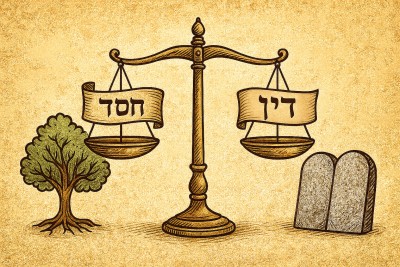
People misunderstand midat ha’din, thinking it means harshness or cruelty. But din is precision, calibrated goodness.
Picture a mother preparing a bottle for her infant. She measures the perfect amount, warms it to the perfect temperature, and makes sure the opening in the bottle’s nipple is small enough for the baby to receive slow, safe drops. A bystander might shout, “Give more! Make the hole bigger! Show chesed!” But the mother knows: too much milk at once would choke the baby.
That’s din — measured kindness perfectly suited to the recipient.
By contrast:
Midat ha’chesed is an outpouring of good, more than we deserve.
But without boundaries, this abundance can overwhelm or destroy. How many lottery winners have lost everything because sudden, unearned wealth crashed over them too quickly?
Avraham embodied limitless chesed. Yitzchak mastered the strength and clarity of din. Eisav carried a natural force of din, but Avraham’s chesed balanced and sweetened him. When Avraham died, Eisav lost his stabilizing anchor.
He should have turned to Yaakov, who inherited Avraham’s chesed. Together, as twins, they were meant to unite their strengths — Yaakov’s kol (voice, spiritual clarity) with Eisav’s yadayim (action, worldly force). This partnership could have transformed the world.
But Eisav’s pride blinded him. He refused to seek Yaakov’s help — he didn’t even thank him for the life-saving guidance against Nimrod. Without Avraham’s chesed and without Yaakov’s partnership, Eisav’s din became wild, unanchored, and explosive.
Later, feeling his lack of chesed, Eisav tried to fill the void by marrying Machalat, daughter of Yishmael. But two unrefined extremes don’t balance — they combust. From that union came Amalek, destruction born from misaligned spiritual forces.
The Blessings: What Could Have Been
When Yaakov entered Yitzchak’s chamber disguised as Eisav, Yitzchak was startled:
“HaKol kol Yaakov v’ha’yadayim y’dei Eisav.”
“The voice is the voice of Yaakov, but the hands are the hands of Eisav.”
Why would Yitzchak give the berachot if he wasn’t sure who stood before him?
Rav Moshe Shapiro, zt”l, explains:
Yitzchak, though physically blind, had deep spiritual clarity. He understood that kol (prayer, voice, spiritual direction) and yadayim (strength, action) are two distinct powers meant to exist together in one ideal person. That was the original destiny of the twins — a unified force of spirituality and action.
Had Yaakov and Eisav joined fully, we might have recited in tefilah:
“Elokei Yitzchak, Elokei Eisav, Elokei Yaakov.”
But Eisav rejected unity. Yaakov absorbed both strengths. Yitzchak blessed him because he saw before him a complete spiritual heir — the person embodying the wholeness that Eisav refused.
Seeing Hashem in Everything
Eisav’s lifelong downfall stemmed from one spiritual failure:
He couldn’t see Hashem’s hand in shocking, unexpected moments.
Instead of strengthening emunah and bitachon, he collapsed into denial and despair.
We must choose differently.
Rav Moshe Shternbuch, shlita, said about a new NYC mayor:
“Nothing is in the Goy’s hands. R’ Chaim Brisker used to say: ‘They want to kill me, but Hashem makes them lazy.’ Even when someone intends harm, Hashem neutralizes them.”
Remain calm and trust in Hashem!
Strengthen your avodat Hashem. Look at the world with balance — through the lens of both chesed and din. Everything unfolding around us is guided with precision and purpose.
May we be zocheh to the geulah soon, bimheirah b’yameinu!
Rabbi Leeor Dahan, a graduate of Yeshiva Chofetz Chaim/ RSA, is a noted scholar and teacher, well-versed in halachah. He currently leads Kehilat Avodat Hashem in Hillcrest, Queens, inspiring his congregation to delve into Torah study and embrace its eternal teachings.
Calm With Chesed And Din
Typography
- Smaller Small Medium Big Bigger
- Default Helvetica Segoe Georgia Times
- Reading Mode